Zinc, lead and ladders
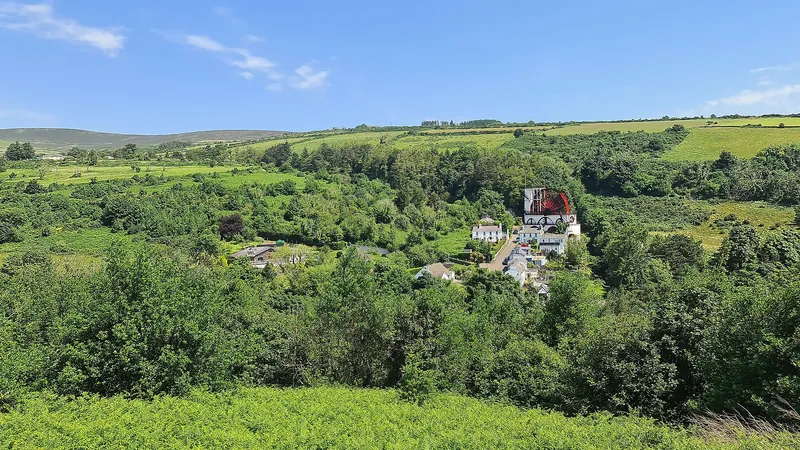
The wheel existed for one reason: the Great Laxey Mine, and the water that kept flooding it.
Lady Isabella and the Great Laxey Wheel are the same wheel. Every fact is in our own words with its source linked beside it. Where good sources disagree, we show each version.
What they dug
The lead ore had a high silver content. Manx National Heritage, Google Arts & Culture
At full production the mine produced more zinc than any other mine in the British Isles. Manx National Heritage, Google Arts & Culture
Visit Isle of Man says it produced half of the UK’s zinc ore output. Visit Isle of Man
At its height the company employed over 600 people. Visit Isle of Man
In 1854 the Illustrated London News reported about 90 tons of silver-lead ore and about 260 tons of zinc ore a month. Illustrated London News, 1854
In 1864 output passed 1,000 tons of lead ore, and the mine raised 5,356 tons of zinc ore. Northern Mine Research Society
The same report counted eight large water-wheels and one steam engine at the works. Illustrated London News, 1854
It was one of several water wheels pumping the Great Laxey Mine, but the largest. Manx National Heritage, learning
How deep
The Engine Shaft, which the wheel pumped, was 247 fathoms deep below adit level. Historically Manx
Sinking of the Engine Shaft began in 1820. Northern Mine Research Society
In 1854 the mine was reported as 200 fathoms deep and getting deeper, which is why such a big wheel was needed. Illustrated London News, 1854
Depths were measured from adit level, which is itself as much as 250 feet underground. British Mining No 3, 1976
How deep did it go?
That is about 452 metres, or 1,483 feet. Manx National Heritage, Google Arts & Culture
The Northern Mine Research Society puts it at about 455 metres below the adit. Northern Mine Research Society
By 1900 the mine was nearly 600 metres deep. Manx National Heritage, Google Arts & Culture
Visit Isle of Man says the mine was more than 670 metres deep. Visit Isle of Man
British Mining No 3 (1976) says the wheel pumped from some 300 fathoms under adit. British Mining No 3, 1976
Some figures are for the Engine Shaft, which the wheel pumped, and some for the whole mine; most are measured from adit level.
A miner’s day
Miners worked two shifts, 6am to 2pm and 2pm to 10pm. Manx National Heritage, learning
Each shift began with a long, slow climb down ladders. Manx National Heritage, learning
Before going down, each man stuck a lump of softened clay on his hat to hold a lit candle. Visit Isle of Man
Between 1831 and 1926, 36 men died in the mines and there were 55 other serious mishaps. Manx National Heritage, learning
The man engine
To save the long climbs, a man engine was put into Welsh Shaft in 1881, but it did not start work until March 1883. Northern Mine Research Society
After 31 men died when a man-engine beam broke at Levant Mine in Cornwall, the Laxey man engine was closed. Northern Mine Research Society
Facing long climbs again, the men went on a strike that lasted three years. Northern Mine Research Society
Above ground
Ore was hauled out of the mine on two small steam locomotives built in 1870. British Mining No 3, 1976
The water pumped from the mine carried toxic metals, including lead, and badly polluted the river. Manx National Heritage, Google Arts & Culture
By the 1890s the best seams were worked out and ore prices were falling, and many miners left for America or Africa. Visit Isle of Man
A water wheel that people now travel to admire was, for most of its working life, part of a hard and dangerous industry. We think the mines trail is worth the walk for that reason alone.
Next: saving the wheel →