From rain to river
The wheel never touched the mine. A long line of rods carried its power across the valley to the pumps.
Lady Isabella and the Great Laxey Wheel are the same wheel. Every fact is in our own words with its source linked beside it. Where good sources disagree, we show each version.
The wheel
There are 168 buckets around the rim. Manx National Heritage, learning Each bucket holds 24 gallons of water. Manx National Heritage, Google Arts & Culture
The wheel’s power is estimated at 185 to 200 horsepower. Manx National Heritage, Google Arts & Culture
The crankshaft alone weighs two and a half tonnes. Manx National Heritage, Google Arts & Culture
The wheel case carries the Isle of Man’s coat of arms, the three legs of Man. Manx National Heritage, Google Arts & Culture
How big is it?
It is 72 feet 6 inches across, which Manx National Heritage gives as over 22 metres. Manx National Heritage, visiting
Manx National Heritage’s news releases give the diameter as 22.1 metres. Manx National Heritage, 2024
The access guide rounds it to 22 metres, or 72.5 feet. MNH access guide, 2026
In 1854 the Illustrated London News reported the wheel as 6 feet broad in the waterway. Illustrated London News, 1854
Same wheel, rounded three ways: 72 feet 6 inches is about 22.1 metres.
Water in
It runs on rainwater from the Laxey hillside, carried by lades and cisterns. Manx National Heritage, learning
The water comes in a closed pipe from a cistern higher than the top of the wheel, and rises up the tower beside it like a siphon. Manx National Heritage, Google Arts & Culture
In 1854 the paper explained the puzzle: there is no aqueduct to the top, because the water rises through an iron tube inside the slender white tower. Illustrated London News, 1854
Water that had already driven a turbine engine higher up the glen was collected and sent down to drive the Great Wheel. Manx National Heritage, Google Arts & Culture
Lady Isabella is a pitchback (backshot) wheel: the water drops into the buckets just before the top, so the wheel turns towards the water tower. Manx National Heritage, Google Arts & Culture
The weight of water in the buckets drives the wheel round. Manx National Heritage, Google Arts & Culture
Pitchback or breast-shot?
The Illustrated London News in 1854 called it a “breast-shot” wheel, not an overshot. Illustrated London News, 1854
British Mining No 3 (1976) calls it a pitch back shot water wheel. British Mining No 3, 1976
Today’s descriptions agree on pitchback; the 1854 reporter used the older word.
Power out
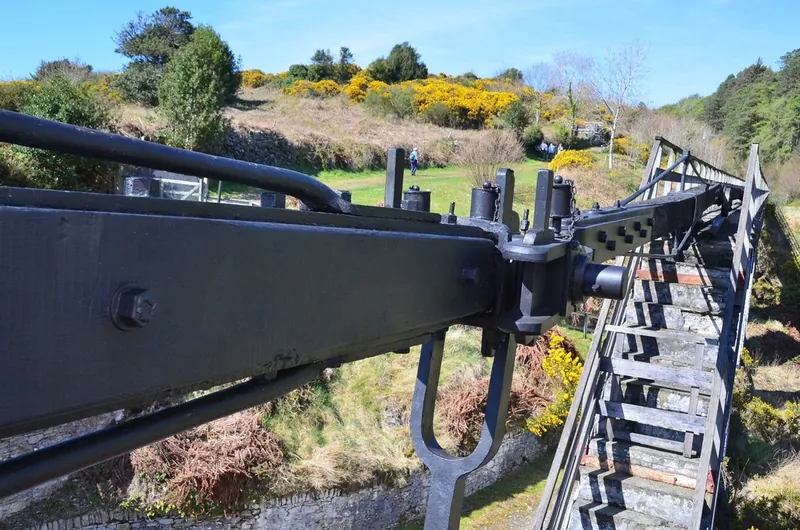
A crank turns the wheel’s round-and-round motion into a push-and-pull along a line of timber rods. Manx National Heritage, Google Arts & Culture
The rod ran on rollers, to cut friction as it was pulled back and forth. Manx National Heritage, Google Arts & Culture Sixteen sets of bogies, little wheels, carry the connecting rods back and forth along the viaduct. Isle of Man Today
At the shaft, a T-rocker turns that back-and-forth push into the up-and-down stroke of the pump rod. Manx National Heritage, learning
The 1854 report gives a 10-foot stroke at the crank and 8 feet in the shaft. Illustrated London News, 1854
The T-rocker weighs nine tonnes and is 10 metres long. Isle of Man Today
Across the valley
The rod duct carrying it is about 200 yards long, built like a Roman aqueduct. Manx National Heritage, Google Arts & Culture The rod duct has 32 arches, with a circular portal between each pair. Manx National Heritage, Google Arts & Culture
The oscillating rod was 210 yards (192 metres) long, made of 17 oak timbers joined with iron plates. Manx National Heritage, Google Arts & Culture
How long are the rods?
The 1854 report gives the line of rods as 600 feet long, of solid oak strapped with wrought iron. Illustrated London News, 1854
Google Arts & Culture puts the pumps in the engine shaft 183 metres (600 feet) from the wheel. Manx National Heritage, Google Arts & Culture
A 2024 Manx National Heritage release says the original 32 arches extended over 169 metres along the valley. Manx National Heritage, 2024
Down the shaft
The Engine Shaft held five pumps, 50 fathoms apart, each lifting the water to the next. Manx National Heritage, Google Arts & Culture
The paper said the wheel could pump 250 gallons a minute from 200 fathoms. Illustrated London News, 1854
The pumps lifted the flood water up to the main adit, where it drained to the Laxey River and the sea. Manx National Heritage, learning
Follow the water
Pick a step to see what happens there.
All six steps are shown below.
Step 1: Rain and the cistern
It runs on rainwater from the Laxey hillside, carried by lades and cisterns. Manx National Heritage, learning
The water comes in a closed pipe from a cistern higher than the top of the wheel, and rises up the tower beside it like a siphon. Manx National Heritage, Google Arts & Culture
Step 2: Up the tower
In 1854 the paper explained the puzzle: there is no aqueduct to the top, because the water rises through an iron tube inside the slender white tower. Illustrated London News, 1854
Water that had already driven a turbine engine higher up the glen was collected and sent down to drive the Great Wheel. Manx National Heritage, Google Arts & Culture
Step 3: Into the buckets
Lady Isabella is a pitchback (backshot) wheel: the water drops into the buckets just before the top, so the wheel turns towards the water tower. Manx National Heritage, Google Arts & Culture
The weight of water in the buckets drives the wheel round. Manx National Heritage, Google Arts & Culture
Step 4: Crank and rods
A crank turns the wheel’s round-and-round motion into a push-and-pull along a line of timber rods. Manx National Heritage, Google Arts & Culture
The rod ran on rollers, to cut friction as it was pulled back and forth. Manx National Heritage, Google Arts & Culture
Step 5: The T-rocker
At the shaft, a T-rocker turns that back-and-forth push into the up-and-down stroke of the pump rod. Manx National Heritage, learning
The 1854 report gives a 10-foot stroke at the crank and 8 feet in the shaft. Illustrated London News, 1854
Step 6: Pumps and the adit
The Engine Shaft held five pumps, 50 fathoms apart, each lifting the water to the next. Manx National Heritage, Google Arts & Culture
The pumps lifted the flood water up to the main adit, where it drained to the Laxey River and the sea. Manx National Heritage, learning
How much water?
The 1854 report said the wheel could pump 250 gallons a minute. Slide to see what that adds up to.
2,500 gallons, about 11,365 litres
Our arithmetic, using 1 imperial gallon = 4.546 litres. The buckets alone hold 168 × 24 = 4,032 gallons between them, though they are never all full at once.
Next: the mine →