Picture credits
The drawings are our own. The photos are from Wikimedia Commons, under Creative Commons licences (Attribution, or Attribution-ShareAlike), CC0, or in the public domain.
Photos
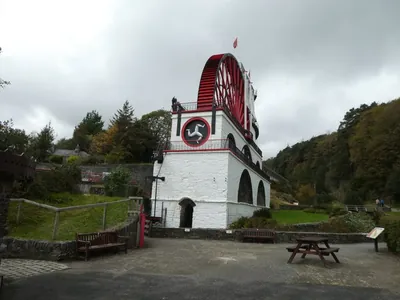 Isle of Man Triskelion seen on the Laxey Wheel - geograph.org.uk - 7634766.jpg
by Basher Eyre, CC BY-SA 2.0. Cropped and resized; no other changes. Shared here under the same licence.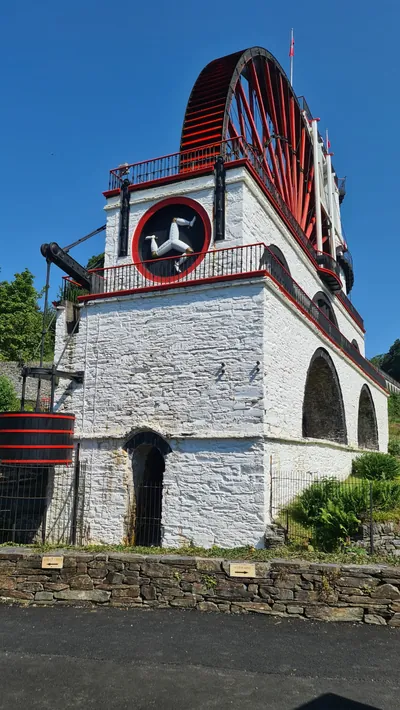 Lady Isabella, the Great Laxey Wheel - geograph.org.uk - 8356263.jpg
by Chris Morgan, CC BY-SA 2.0. Cropped and resized; no other changes. Shared here under the same licence.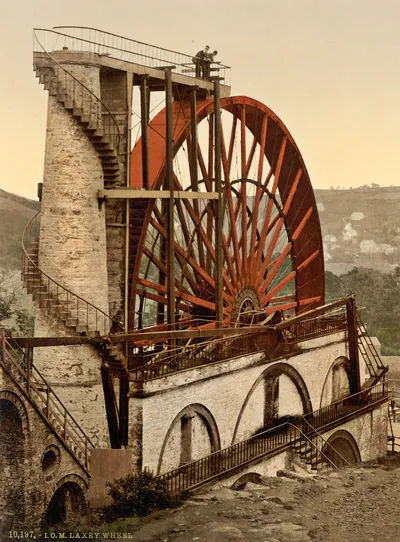 Laxey Wheel 08676u.jpg
by Unknown photographer (photochrom, Library of Congress), Public domain. Cropped and resized; no other changes.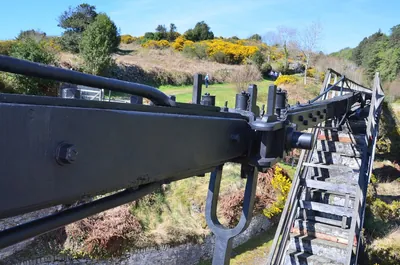 Connection to the pumping beam, Laxey Wheel - geograph.org.uk - 4449428.jpg
by Jim Barton, CC BY-SA 2.0. Cropped and resized; no other changes. Shared here under the same licence.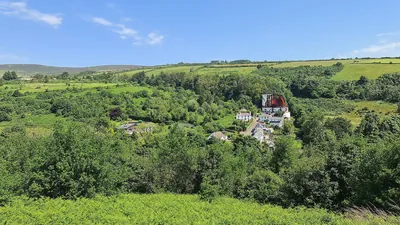 Lady Isabella, the Great Laxey Wheel in its setting - geograph.org.uk - 8356553.jpg
by Chris Morgan, CC BY-SA 2.0. Cropped and resized; no other changes. Shared here under the same licence.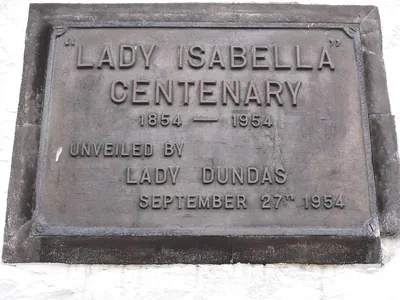 Commemorative plaque on the Laxey Wheel - geograph.org.uk - 2112023.jpg
by Shazz, CC BY-SA 2.0. Cropped and resized; no other changes. Shared here under the same licence.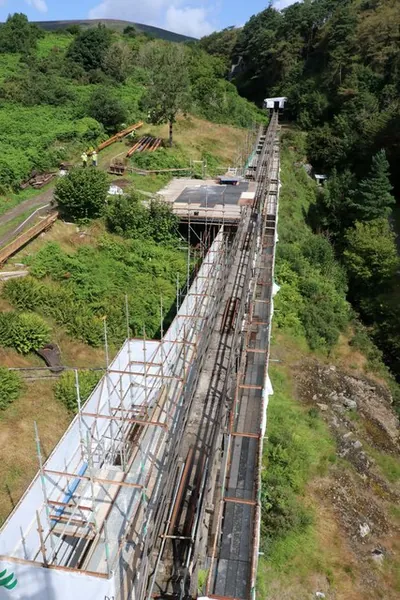 Flat rod viaduct from Lady Isabella waterwheel - geograph.org.uk - 7845139.jpg
by Chris Allen, CC BY-SA 2.0. Cropped and resized; no other changes. Shared here under the same licence.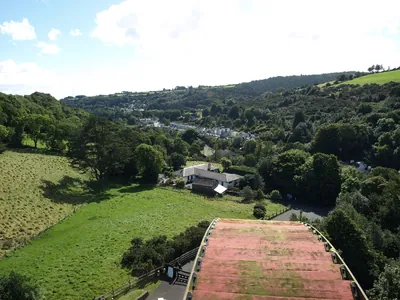 From the top of the Laxey wheel - geograph.org.uk - 3143855.jpg
by Andrew Abbott, CC BY-SA 2.0. Cropped and resized; no other changes. Shared here under the same licence.
Our own drawings
- A simplified front view of the Great Laxey Wheel: a big red wheel with many spokes and buckets around its rim, the three legs of Man on a red and white disc at the centre, white masonry arches below, and a tall white water tower on the right with a spiral stair. A blue pipe runs from the top of the tower to the top of the wheel, and a viewing platform sits above the wheel. Labels: 72 feet 6 inches, about 22 metres across; 168 buckets around the rim; water rises inside the tower like a siphon; spiral stair, 95 or 96 steps, sources differ.
Our own drawing - A cut-away diagram of the whole system in six numbered steps. 1: a cistern on the hillside feeds a pipe. 2: the pipe drives the wheel. 3: a crank on the wheel pushes and pulls a long line of rods along a row of arches, the rod duct. 4: at the far end a T-rocker turns the movement downwards. 5: a pump rod goes down the Engine Shaft, with pumps every 50 fathoms lifting water upwards. 6: the water flows out along the Main Adit to the Laxey River and the sea. A note says the drawing is not to scale: the shaft went down hundreds of metres.
Our own drawing - A diagram of the motion. On the left, a crank on the wheel’s axle turns in a circle. It pushes and pulls a long timber rod, which rides on small wheels called bogies. On the right the rod meets a T-shaped rocker on a pivot, which turns the push and pull into an up-and-down movement in the shaft. Labels give the 1854 report’s figures: a 10-foot stroke at the crank and 8 feet in the shaft.
Our own drawing - Three water wheels side by side. Overshot: the water channel runs right over the top and the wheel turns away from it. Pitchback, or backshot: the channel stops just before the top, the water drops in and the wheel turns back towards the channel. Breast-shot: the water meets the wheel lower down. A note says today’s sources call Lady Isabella a pitchback wheel; the 1854 newspaper called it breast-shot.
Our own drawing - A to-scale chart of depths below ground. A tiny red circle at the top stands for the 22-metre wheel. Four bars hang down: the Engine Shaft, 247 fathoms or about 452 metres; the Engine Shaft at about 455 metres, from the Northern Mine Research Society; the mine by 1900, nearly 600 metres; and the mine at more than 670 metres, from Visit Isle of Man.
Our own drawing - A vertical timeline: 1780s, zinc and lead ore found; 1797, main adit driven; 1820, Engine Shaft begun; 1836, river floods the mine; 1848, Laxey Mining Company; 1854, Lady Isabella opens; 1864, over 1,000 tons of lead ore; 1883, man engine at work; 1929 to 1934, mine closes, sources differ; 1937, Edwin Kneale leases the wheel; 1946, Kneale buys it; 1965, given to the Manx Government; 2020, wheel stops; 2022, turning again; 2024, phase 2 on the rods and T-rocker.
Our own drawing
The drawings are simplified teaching drawings, not to scale, made from the sourced descriptions on this site. Useless the eraser is the network’s own mascot. Fonts: Bricolage Grotesque, Newsreader and Kalam (SIL Open Font Licence), served from this site.